Thursday, 6 October 2011

Facebook Page

There are 1000 pageviews of our website per Day but why is our FB page left behind???

please like the page

Link

Refer it to to your friends also

Come for the Draconids and celebrate the World Space Week

It is an exiting opportunity....don't miss it...

People from India can Join SIASE and its members for an overnight observation.

Contact ----- abhishek.arora1996@gmail.com

                    OR
  9711234898


This is Just for People living in new delhi and NCR region


Wednesday, 5 October 2011

Draconids Meteor Shower on 8 October 2011

What will happen?

Several studies1 predict that on 8 October 2011, Earth will encounter several trails of dust produced by comet 21P/Giacobini–Zinner in the late 19th and early 20th century. This is expected to cause a moderate enhancement in the meteor activity. The precise number of meteors is highly uncertain, but estimates suggest a peak level of up to 1 to 10 shooting stars per minute. Unfortunately, only 5 to 20% of these meteors will be visible because of the disturbing light from a nearly full moon, so observers are likely to see only 1 meteor per minute or less. However, the event is of great interest to scientists because it will help them understand how meteor showers form and evolve.

When will this be visible?

The meteor activity of the Draconids (DRA) is expected to be enhanced on 8 October 2011 between 16h00m and 21h00m Universal Time (UTC). Predictions suggest a peak of faint meteors around 20h00m (±30m) UTC, caused by dust produced by the comet in 1900 and 1907 AD. Earth previously encountered these dust trails in 1933 and 1946, producing strong meteor storms on those occasions. Such exceptional meteor activity is not expected this year, because the trails are now older and more dispersed. There could be additional peaks earlier in the evening, between 16h00m and 19h00m UTC, if the comet also produced dust before its discovery in 1900 AD. These meteors are likely to be brighter.
Use the table below to look up the local time in your time zone.

Time zoneEnhanced activityMain peak?
Universal Time UTC (Casablanca, Dakar)16h - 21h~20h
West Europe (London, Dublin)17h - 22h~21h
West Africa (Algiers, Tunis, Lagos)17h - 22h~21h
Central Europe (Berlin, Paris, Rome)18h - 23h~22h
East Europe (Helsinki, Kiev, Istanbul)19h - 24h~23h
Russia (Moscow)20h - 01h~24h
Russia (Novosibirsk, Tomsk)23h - 04h~03h
India21h30 - 02h30below horizon
China24h - 05hbelow horizon
Japan01h - 06hbelow horizon
Americasdaylightdaylight

Where will this be visible?

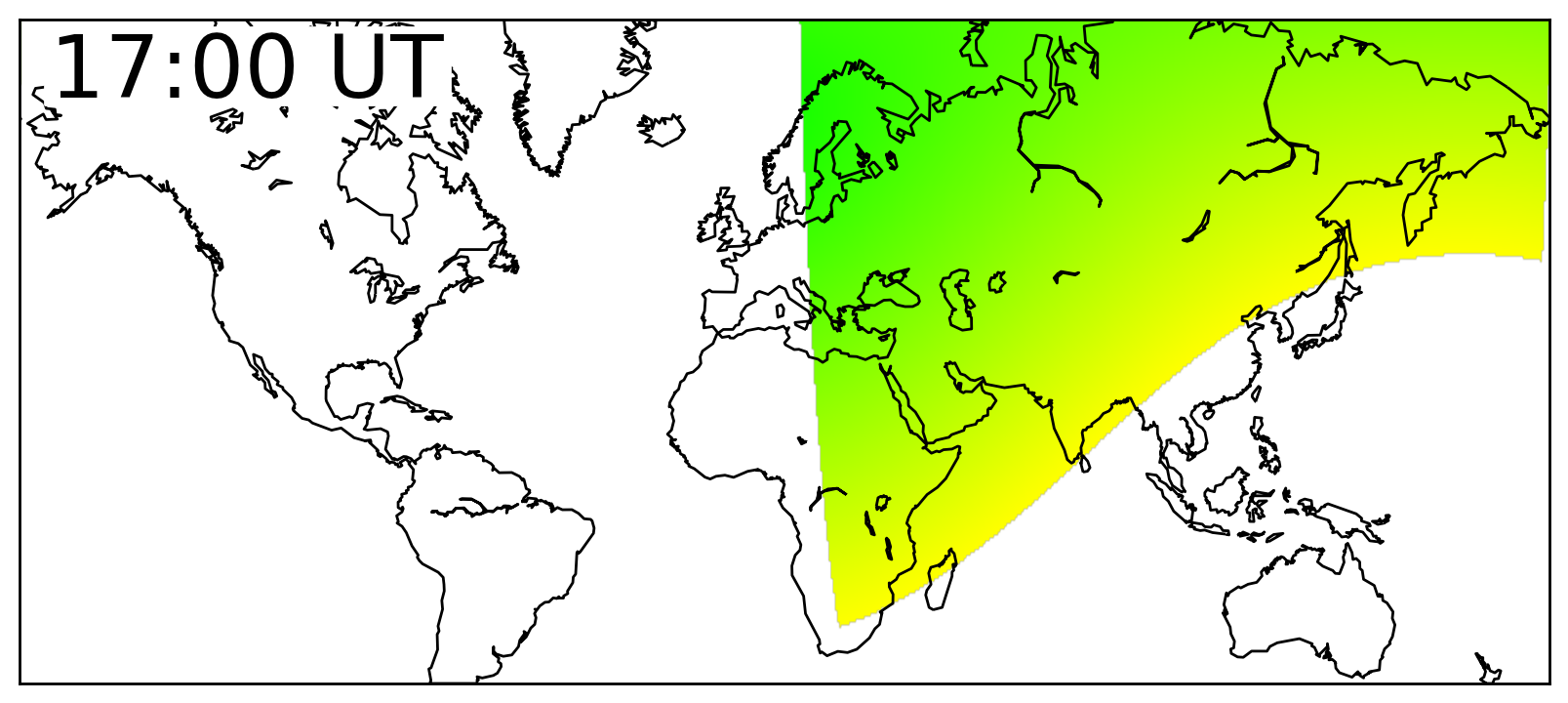
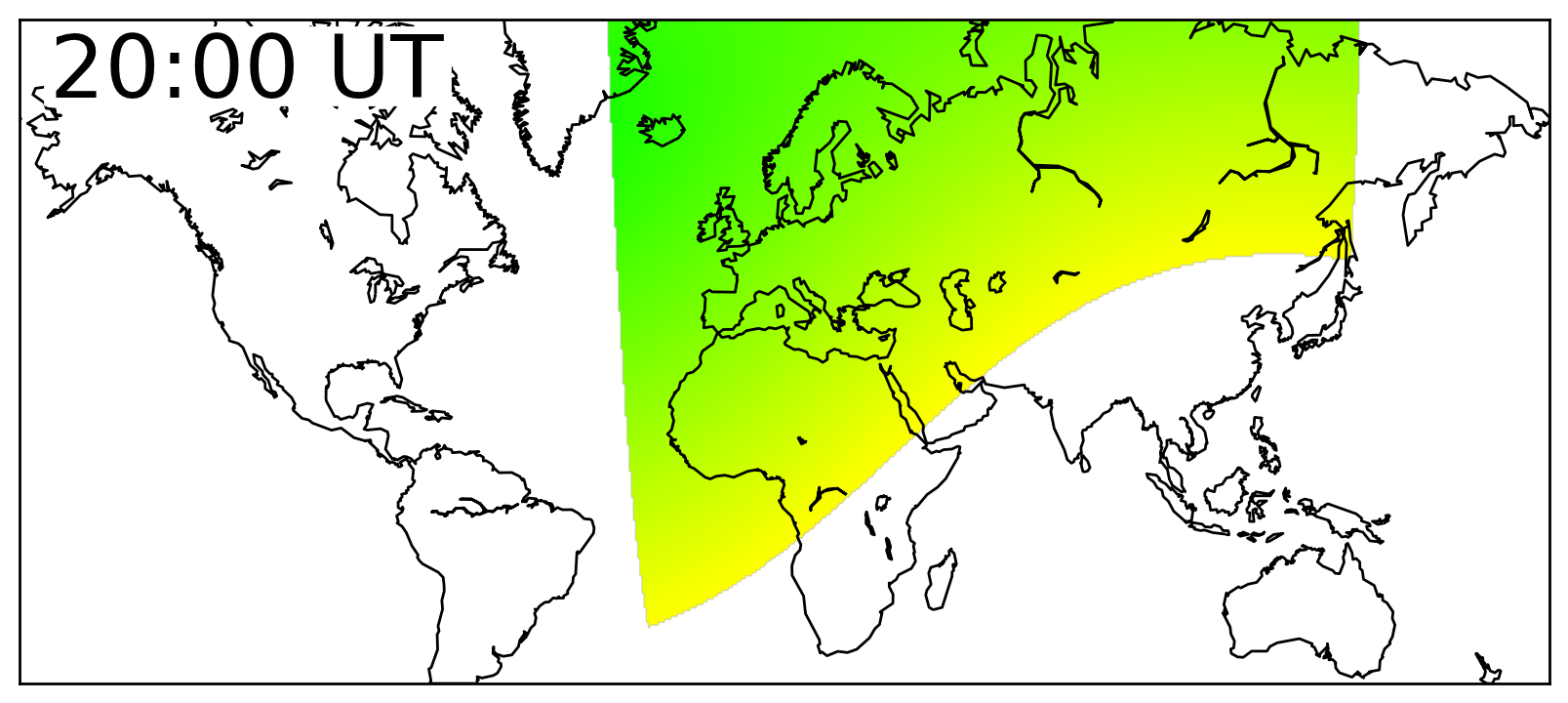
The enhanced activity will be visible from Europe, North Africa and North/West Asia. The green areas in the maps below show the regions which will be dark (Sun 6 degrees below horizon) and oriented towards the dust trail (radiant above horizon) at 17h00m and 20h00m UTC on 8 October 2011. The event will not be visible outside these areas.


Map source code: plot_visibility_map.py (Python script)

Where should I look?

The meteors will appear to radiate from the constellation of Draco, which is located in the North-Western part of the sky from most locations. However, meteors may appear anywhere in the sky, so just look up!

Saturn's Geyser Moon Enceladus Shows Off for NASA's Cassini

NASA's Cassini spacecraft successfully completed its Oct. 1 flyby of Saturn's moon Enceladus and its jets of water vapor and ice. At its closest approach, the spacecraft flew approximately 62 miles (100 kilometers) above the moon's surface. The close approach was designed to give some of Cassini's instruments, including the ion and neutral mass spectrometer, the chance to "taste" the jets themselves.

At a higher vantage point during the encounter, Cassini's high-resolution camera captured pictures of the jets emanating from the moon's south polar region. The latest raw images of Enceladus are online at: http://saturn.jpl.nasa.gov/photos/raw/ .
The images of the surface include previously seen leading-hemisphere terrain. However, during this encounter, multi-spectral imaging of these terrains extended farther into the ultraviolet region of the electromagnetic spectrum than had previously been achieved at this resolution. By looking at the surface at ultraviolet wavelengths, scientists can better detect the difference between surface materials and shadows than they can at visible wavelengths, where icy materials are highly reflective and shadows are washed out. With both ultraviolet and visible images of the same terrain available to them, scientists will better understand how the surface coverage of icy particles coming from the vents and plumes changes with terrain type and age.
Cassini's next pass of this fascinating moon will be Oct. 19, when the spacecraft flies by at an altitude of approximately 765 miles (1231 kilometers).
The Cassini-Huygens mission is a cooperative project of NASA, the European Space Agency and the Italian Space Agency. The Jet Propulsion Laboratory, a division of the California Institute of Technology in Pasadena, manages the mission for NASA's Science Mission Directorate, Washington. The Cassini orbiter and its two onboard cameras were designed, developed and assembled at JPL. The imaging operations center is based at the Space Science Institute in Boulder, Colo. The Ion and Neutral Mass Spectrometer science team is based at the Southwest Research Institute, San Antonio, Texas.
For more information about the Cassini-Huygens mission, visit http://www.nasa.gov/cassini and http://saturn.jpl.nasa.gov .